

Agricultural, Mechanical, Automobile and Civil Engineering (Degree Standard) – Subject Paper (Paper II)
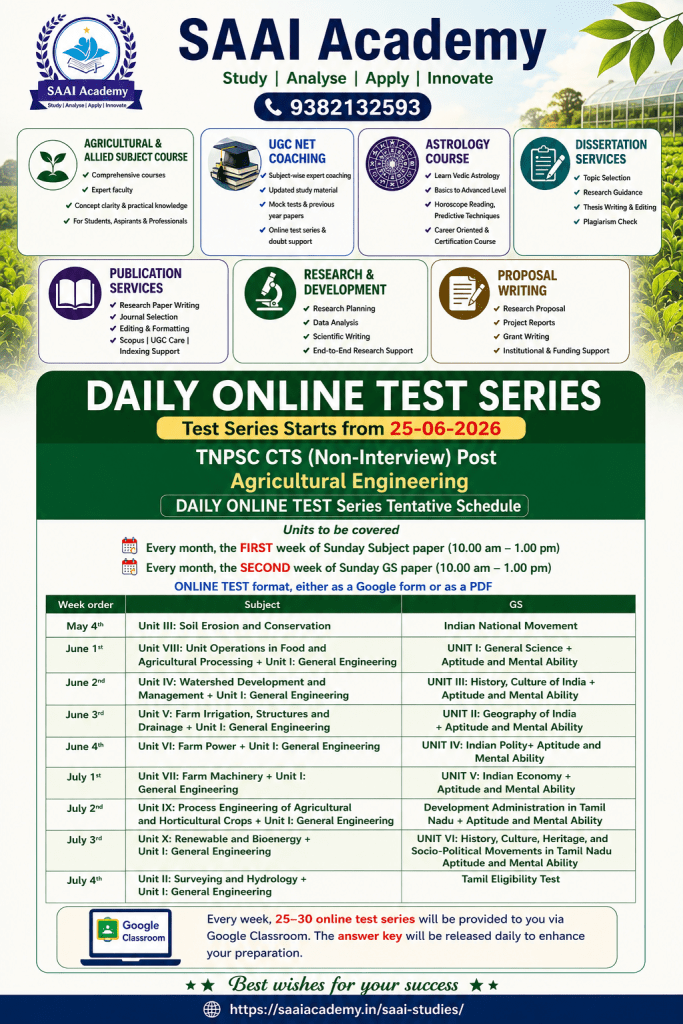
Online test series module plan
Model Test Series Question bank
Code: 562
Get updated about the current affairs and Competitive Exam preparation through: https://chat.whatsapp.com/GB3jtldUb6NDAF4FIdKhDd
Unit I: General Engineering (20 Questions) Statics of Particles, Equilibrium of Rigid bodies, Properties of Surfaces and Solids, Centroid, Centre of Gravity, Dynamics of Particles, Friction in Machine Elements, Stress, Strain and Deformation of Solids, Theories of Failures, Design of Shafts and Couplings, Fluid statics, equations of continuity and momentum, Bernoulli’s equation, Flow through pipes, head losses in pipes, bends, Pumps and its applications, Valves and Types, Iron Carbide Phase Diagram, ferrous and nonferrous alloys, Heat treatment of ferrous and non-ferrous metal, Engineering and commodity polymers, composites, nano-materials, Foundry Technology- Metal Forming Processes, Metal Joining processes, Manufacturing of Thermo Setting and Thermo Plastic Products, Inventory control – Economic Order Quantity (EOQ) – quantity discounts, ABC Analysis, Operations Research, Assignment Model, Critical Path Method (CPM) and Program Evaluation Review Technique (PERT), Queuing Models, Industrial Safety.
Unit II: Surveying and Hydrology (20 Questions) Surveying – Instruments – Methods of surveying – Linear measurements – Computation of area – Triangulation, intersection, traversing, cross staff survey – Plane table survey – Earth work computation – Simpson’s and trapezoidal rule – Levelling – Definition – Types of benchmarks – Different types of levels – Reduced level by rise and fall method and height of collimation method – Contouring – Profile surveying – Cross section survey – Use of Minor instruments – Theodolite survey – Total station – GPS survey. Hydrology – Measurement of rainfall, evaporation and infiltration – Estimation of runoff – Factors affecting runoff – Computation of volume of runoff and peak flow – Unit hydrograph – Occurrence and movement of ground water – ground water exploration techniques – hydraulics of wells, types of wells and their construction – Well drilling – Methods and machinery – Techniques for different formations – Well logging – Types of well screen – Design of well screens – Well development – Yield testing.
Unit III: Soil Erosion and Conservation (15 Questions) Soil erosion – Types – Factors affecting erosion by water and wind – Stages of water erosion – Biological control measures and their suitability – Contour farming, strip cropping, mixed cropping, intercropping and mulching – Mechanical control measures and their suitability – Design and construction of contour bunds, graded bunds, terraces, contour stone walls, contour trenches, staggered trenches and diversion drain – Gully control structures – Drop spillway, chute spillway, pipe inlet spill way and check dams – Wind erosion – Types and control – Wind breaks and shelter belts – Dry farming techniques for improving crop production – Estimation of soil erosion – Universal Soil Loss Equation.
Unit IV: Watershed Development and Management (15 Questions) Watershed – Concept, types and delineation – Land capability classification – Participatory Rural Appraisal Technique – Watershed development plan – Estimation of cost and benefits – Gully and ravine reclamation – In-situ & Ex-situ water harvesting, micro catchments – Ground water recharge – Artificial recharge techniques and methods – Farm pond and percolation pond – Selection of suitable soil and water conservation practices – Afforestation – Holistic planning – Watershed based rural development – Use of aerial photography and remote sensing in watershed management – Applications of Remote sensing and GIS in planning and development of watersheds including forest cover and water resources.
Unit V: Farm Irrigation, Structures and Drainage (30 Questions) Irrigation – Sources – Soil-water-Plant relationship – Water requirement of crops – Measurement of irrigation water – Weirs and flumes – Methods of irrigation – Surface, Sprinkler, Rain gun and drip irrigation – Irrigation automation – Drip irrigation – Components and design – Wetting pattern – Filters and Fertigation tanks – Pump capacity – Operation and maintenance – Sprinkler irrigation – Components – Sprinkler performance – Hydraulic design of sprinkler systems – Duty and delta relationship – Irrigation scheduling – Irrigation efficiencies and their estimation – Pumps – Types, selection and installation – Design and construction of farm structures – Site selection – Quality – RCC – Foundation, basement and superstructure – Types of roofs – building plan and estimation, requirements of farm house, threshing floor, drying floor, poultry house, dairy farm, rat proof go down and farm roads – Design features earthen dams and gravity dams – Water conveyance structures – Earthen channels and lined channels – Advantages of lining – materials of lining – Design of channel cross section – Crossing control structures – Road crossing structures – Culvert, inverted siphon aqueduct – Their uses – Underground pipe line system – Components and their functions – Structures for plant environment – Green houses, poly houses and shade nets – Construction and utilization – Soilless culture. Drainage – Causes of water logging and salt problem – Methods of drainage – Design of surface, sub-surface and vertical drainage systems – Improvement and utilization of poor quality water – Reclamation of saline and alkali soils.
Unit VI: Farm Power (20 Questions) Sources of Farm Power- Construction and working of Spark Ignition (SI) and Compression Ignition (CI) engines- Thermodynamic principles of SI and CI engine – Two stroke and Four stroke engines – Turbo charging – Fuel injection systems, Ignition, Lubrication and Cooling systems, Speed governors, Electrical systems of Internal Combustion engines – Different types of tractors, bull dozers and power tillers – power transmission systems, Types of Clutches and Gearboxes, Differential, Final drive system, Braking system – types, constructional details and operation, Steering system – types, constructional details and operation, Suspension system – types, constructional details, uses of hydraulic system in tractors, hitching system, three point linkage- tractor power outlets. Resistances to vehicle motion, vehicle performance characteristics, Operations using bull dozer, Types of wheels and tyres – Battery: types, constructional details and working principle. Tractor stability – mechanics of tractor implement combination, weight transfer – Ergonomic considerations in operation of tractors, Safety devices in tractors, Maintenance of tractors. Single phase induction motor – three phase power measurement methods- Power factor- Electrical pump sets – regulated DC power supply, DC machine, DC generator, DC motor, starter – torque and efficiency – Electronics in Agriculture – Semi-conductors, transistors, operational amplifiers – Digital electronics, counters, encoders, decoders, Digital to Analog and Analog to digital converter- Instrumentation – transducers – strain gauges, types and gauge factor – force measurement using strain gauges, Torque measurement, pressure measurement, flow measurement temperature measurement, thermocouples, speed measurement microprocessors, microcontrollers, PID controllers, PLC – Electric vehicles in Agriculture.
Unit VII: Farm Machinery (20 Questions) Earth moving equipment – Back hoe with front end loader, Crawler excavator – Bull dozer – bladeshoves- soil digging machines- primary tillage implements- indigenous plough, Mould board plough, disc plough, chisel plough, sub boiler, methods of ploughing – secondary tillage implements- cultivators, harrows, rotary tillers, rotavator, land shaping machinery- laser leveller, ridger, bund former, raised bed former, puddler. Calculation of field capacity, field efficiency. Sowing and transplanting – seed drills, types – different types of metering mechanisms, planters, broadcasters and rice transplanters, pneumatic planters- intercultural implements – dryland weeders, wetland weeders, manual and power operated weeders – plant protection equipments – sprayers – types of sprayers – Drone sprayer – calibration of sprayer, types of nozzles, drift – harvesters – sickle, mower, cutter bar, reaper, binders, windrowers – threshers – principle of threshing, types of threshers, threshing drums, calculation of output capacity, combines, working principles, components of combine. Root crop harvesters, cotton harvesters, cotton strippers, sugarcane harvester, maize harvesters, vegetable and fruit harvesters, crop residue management machinery – cost estimation of farm machinery.
Unit VIII: Unit Operations in Food and Agricultural Processing (20 Questions) Heat transfer principles – Conduction, convection and radiation – Types of heat exchangers – Unit operations – Evaporators – Types – Mechanical separation – Filtration – Sedimentation – Settling – Centrifugal separation – Cyclone separation – Size reduction – Mixing – Blending – emulsification – Food processing operations – Pasteurization – Sterilization – Canning – Retort processing – Extrusion processing of foods – Methods of drying of foods – Preservation of food by irradiation – Microwave and dielectric heating – Fats and oil processing – Extraction methods and equipment – Food packaging – Materials and characteristics – Suitability – Processing of milk and milk products, packaging of milk – Principles of refrigeration and applications in food industries – Cold storage of fruits and vegetables – Design aspects
Unit IX: Process Engineering of Agricultural and Horticultural crops (20 Questions) Engineering properties of food materials – Moisture content – Methods of determination – Psychrometry – Drying – Thin layer and deep bed drying – Types of heat sources and types of dryers – Cleaning and grading – Principles – Separators – Efficiency – Performance index – Shelling and decortication – Seed processing and layout of seed processing units – Rice processing – Parboiling and dehushing of paddy – Machines used – Milling of corn, pulses and millets – Material handling equipments – Conveyors and elevators – Storage – Conditions for safe storage – Bag and bulk storage – Silo storage – Design aspects – Modified atmosphere storage – Storage structures – Equipment used for processing of horticultural crops – Preservation of fresh fruits and vegetables – Drying and dehydration – Processing of coffee, tea, rubber, cashew nut, coconut, oil palm, aromatic plants, flowers and spices.
Unit X: Renewable and Bioenergy (20 Questions) Solar energy – Solar collectors – Air heaters – Solar dryers – Water heaters – Solar cold storage – Solar photovoltaic systems and applications- Solar PV pump, fencing – Wind energy – Suitable sites – Types of wind mills – Wind mill components – Applications – Performance of wind mills – Biomass resources – Agro residues – Characteristics – Conversion technologies – Biochemical conversion – Biogas plant – Types and selection, construction, operation and maintenance – Slurry handling – Thermochemical conversion – Stoves – Types – Improved stoves – Pyrolysis – Charcoal production – Gasification – Briquetting – Alternate renewable energy systems – Hydro power, Geothermal, ocean and hydrogen energy- Energy storage systems- Energy Conservation- Cogeneration – Energy plantation and environmental impact – Global warming – Clean development mechanism (CDM) and role of afforestation – Biofuels – Biodiesel feedstock, production and by-product utilization – Ethanol – Production and utilization – Emission – Standards and control.
Part B: General Studies (Paper I)
UNIT I: General Science (5 Questions) Scientific knowledge and scientific temper – Power of reasoning – Rote learning vs conceptual learning – Science as a tool to understand the past, present, and future; Nature of universe – General scientific laws – Mechanics – Properties of matter, force, motion, and energy – Everyday application of the basic principles of mechanics, electricity and magnetism, light, sound, heat, nuclear physics, laser, electronics, and communications; Elements and compounds, acids, bases, salts, petroleum products, fertilizers, pesticides; Main concepts of life science, classification of living organisms, evolution, genetics, physiology, nutrition, health and hygiene, human diseases; Environment and ecology; Latest inventions in science and technology; Current affairs.
UNIT II: Geography of India (5 Questions) Location – Physical features – Monsoon, rainfall, weather and climate – Water resources – Rivers in India – Soil, Minerals and Natural Resources – Forest and Wildlife – Agricultural pattern; Transport – Communication; Social Geography – Population density and distribution – Racial, linguistic groups and major tribes; Natural calamity – Disaster management; Environmental pollution – Reasons and preventive measures – Climate change – Green energy; Geographical landmarks; Current affairs.
UNIT III: History, Culture of India, and Indian National Movement (10 Questions) Indus Valley Civilization – Guptas, Delhi Sultans, Mughals, and Marathas – Age of Vijayanagaram and Bahmani Kingdoms – South Indian History; National Renaissance – Early uprising against British rule – Indian National Congress – Emergence of leaders – B.R.Ambedkar, Bhagat Singh, Bharathiar, V.O.Chidambaranar, Jawaharlal Nehru, Kamarajar, Mahatma Gandhi, Maulana Abul Kalam Azad, Thanthai Periyar, Rajaji, Subash Chandra Bose, Rabindranath Tagore, and others; Different modes of agitation: Growth of Satyagraha and Militant Movements; Communalism and Partition; Change and continuity in the socio-cultural history of India; Characteristics of Indian Culture, Unity in Diversity – Race, Language, Custom; India as a secular state, Social harmony; Prominent personalities in various spheres – Arts, Science, Literature and Philosophy.
UNIT IV: Indian Polity (15 Questions) Constitution of India – Preamble to the Constitution – Salient features of the Constitution – Union, State and Union Territory – Citizenship, Fundamental Rights, Fundamental Duties, Directive Principles of State Policy – Union Executive, Union Legislature – State Executive, State Legislature – Local Governments, Panchayat Raj – Spirit of federalism: Centre – State relationships – Election – Judiciary in India – Rule of Law – Corruption in public life – Anti-corruption measures – Lokpal and Lok Ayukta – Right to Information – Empowerment of Women – Consumer Protection Forums, Human Rights Charter; Political parties and political system in India; Current affairs.
UNIT V: Indian Economy and Development Administration in Tamil Nadu (20 Questions) Nature of Indian Economy – Five-year plan models – an assessment – Planning Commission and Niti Aayog; Sources of revenue – Reserve Bank of India – Fiscal Policy and Monetary Policy – Finance Commission – Resource sharing between Union and State Governments – Goods and Services Tax; Structure of Indian Economy and Employment Generation, Land Reforms and Agriculture – Application of Science and Technology in Agriculture – Industrial growth – Rural welfare oriented programmes – Social problems – Population, Education, Health, Employment, Poverty; Human Development Indicators in Tamil Nadu and a comparative assessment across the Country – Impact of social reform movements in the socio-economic development of Tamil Nadu – Political parties, and welfare schemes for various sections of people – Rationale behind the reservation policy, and access to the social resources – Economic trends in Tamil Nadu – Role and impact of social welfare schemes in the socio-economic development of Tamil Nadu – Social Justice and social harmony as the cornerstones of socio-economic development; Education and health systems in Tamil Nadu; Geography of Tamil Nadu and its impact on economic growth; Achievements of Tamil Nadu in various fields; e-Governance in Tamil Nadu; Public awareness and General administration – Welfare oriented Government schemes and their utility, Problems in public delivery systems; Current socio-economic issues; Current affairs.
UNIT VI: History, Culture, Heritage, and Socio-Political Movements in Tamil Nadu (20 Questions) History of Tamil Society, related archaeological discoveries, Tamil literature from Sangam age till contemporary times – Thirukkural – Significance as a secular literature – Relevance to everyday life, Impact of Thirukkural on humanity, Thirukkural and universal values – Relevance to Socio-politicoeconomic affairs, Philosophical content in Thirukkural; Role of Tamil Nadu in freedom struggle – Early agitations against British Rule – Role of women in freedom struggle; Evolution of 19th and 20th century socio-political movements in Tamil Nadu – Justice Party, Growth of Rationalism – Self Respect Movement, Dravidian Movement, and principles underlying both these movements; Contributions of Thanthai Periyar and Perarignar Anna.
PART C: Aptitude and Mental Ability (SSLC STANDARD)
UNIT I: Aptitude (15 Questions)
Simplification – Percentage – Highest Common Factor (HCF) – Lowest Common Multiple (LCM) – Ratio
and Proportion – Simple interest – Compound interest – Area – Volume – Time and Work.
UNIT II: Reasoning (10 Questions)
Logical reasoning – Puzzles – Dice – Visual reasoning – Alpha numeric reasoning – Number series.
Part A – Tamil Eligibility Test (Paper I) Code: 503
அலகு I: இலக்கணம் (25 கேள்விகள்) எழுத்து: பிரித்து எழுதுதல் – சேர்த்து எழுதுதல் – சந்திப்பிழை – குறில், நெடில் வேறுபாடு – லகர, ளகர, றகர வேறுபாடு – னகர, ணகர வேறுபாடு – ரகர, றகர வேறுபாடு – இனவெழுத்துகள் அறிதல் – கூட்டு எழுத்துகள் – வினா எழுத்துகள் – ஒருமைப் பன்மை அறிதல். சொல்: வேற்சொல் அறிதல் – வேற்சொல்லில் இருந்து வினைமுற்று, வினையெச்சம், வினையாலணையும் பெயர், பெயரெச்சம் வகை அறிதல் – அயற்சொல் தமிழ்ச்சொல், எதிர்ச்சொல் வினைச்சொல் – எழுத்துப்பிழை, ஒற்றுப்பிழை அறிதல் – இரண்டு வினைச் சொற்களின் வேறுபாடு அறிதல்.
அலகு II: சொல்லகதி (15 கேள்விகள்) (i) எதிர்ச்சொல்லை எடுத்தெழுதுதல், ஓரெழுத்து ஒரு மொழி, உரிய பொருளைக் கண்டறிதல் – ஒருபொருள் தரும் பல சொற்கள், பொருந்தா சொல்லைக் கண்டறிதல், அகர வரிசைப்படி சொற்களைச் சீர்செய்தல்; ஒருபொருள் பன்மொழி – இருபொருள் குறிக்கும் சொற்கள் – பேச்சு வழக்கு, எழுத்து வழக்கு – சொல்லும் பொருளும் அறிதல் – ஒரு சொல்லிற்கு இணையான வேறு சொல் அறிதல். (ii) கோடிட்ட இடத்தில் சரியான சொல்லைத் தேர்ந்தெடுத்து எழுதுதல் – (எ.கா.) பள்ளிக்குச் சென்று கல்வி பயிலுதல் சிறப்பு (பயிலுதல், எழுதுதல்) – வானில் முக்கி தோன்றினால் மழை பொழியும் (முகில், நட்சத்திரம்); பொருத்தமான பொருளைத் தெரிவு செய்தல் – (எ.கா.) ஊடகம் – தகவல் தொடர்புச் சாதனம் (செய்தி, தகவல் தொடர்புச் சாதனம்) – சமூகம் – மக்கள் குழு (மக்கள் குழு கூட்டம்); ஊர்ப் பெயர்களின் மரூஉவை எழுதுக – (எ.கா) புதுச்சேரி – புதுவை, மன்னார்குடி- மன்னை, மயிலாப்பூர் – மயிலை; பிழை திருத்துக (எ.கா) ஒரு – ஓர் பேச்சு வழக்குச் சொற்களுக்கு இணையான தூய தமிழ்ச் சொற்களை இணைத்தல் – (எ.கா) வெத்தில – வெற்றிலை, நாற்காலி – நாற்காலி. (iii) பேச்சு வழக்குத் தொடர்களினுள்ள பிழை திருத்தம் – (எ.கா.) நேத்து மழ பெயஞ்சது – நேற்று மழை பெய்தது; சொற்களை இணைத்துப் புதிய சொல் உருவாக்குதல்: மற்றும், அல்லது. ஆல், பிறகு வரை, இதுவுமல்ல, இருப்பினும், எனினும், இதனால்; அடைப்புக்குள் உள்ள சொல்லைத் தகுந்த இடத்தில் சேர்த்தல் – (எனவே, ஏனெனில், ஆகையால், அதுபோல, அதனால், வரை, பின்பு) – (எ.கா) நான் காட்டிற்குச் சென்றேன். அதனால் புலியைப் பார்த்தேன் – மாலைநேரம் முடியும் வரை விளையாடுவேன். தேர்வு முடிந்த பின்பு சுற்றுலா செல்லலாம்; பொருள் தரும் ஓர் எழுத்து – (எ.கா) ஆ-பசு, ஈ-கொடு, தை-மாதம், தீ-நெருப்பு; பல பொருள் தரும் ஒரு சொல்லைக் கூறுக – (எ.கா) கமலம், கஞ்சம், முளரி, பங்கயம் இச்சொற்கள் தாமரையைக் குறிக்கும்.
அலகு III: எழுதும் திறன் (15 கேள்விகள்) (i) சொற்களை ஒழுங்குபடுத்திச் சொற்றொடர் அமைத்தல் – தொடர் வகைகள் – செய்வினை, செயப்பாட்டு வினை – தன்மை, முன்னிலை – ஒருமைப் பன்மை பயின்று தொடர்தல். (ii) மரபுத் தமிழ்: திணை மரபு – உயர்திணை: அம்மா வந்தது – அம்மா வந்தாள்: அஃறிணை: மாடுகள் நனைந்தது – மாடுகள் நனைந்தன; பால் மரபு: ஆண்பால்: அவன் வந்தது – அவன் வந்தான்; பெண்பால்: அவள் வந்தது – அவள் வந்தாள்; பலர் பால்: அவர்கள் வந்தார்கள் – அவர்கள் வந்தனர்; ஒன்றன் பால்: அது வந்தன – அது வந்தது; பலவின் பால்: பறவைகள் பறந்தனர் – பறவைகள் பறந்தன; காலம்: நேற்று மழை பெய்யும் – நேற்று மழை பெய்தது; நேற்று வருவேன் – நேற்று வந்தேன்; இளமைப் பெயர்: பசு – கன்று; ஆடு – குட்டி; ஒலிமரபு: நாய் கத்தியது – நாய் குறைத்தது; வினைமரபு: குடைமுடை, சோறு உண்; தொகை மரபு: மக்கள் கூட்டம் – ஆட்டு மந்தை, நிறுத்தல் குறியீடுகள்: கால்புள்ளி, அரைப் புள்ளி, முக்கால் புள்ளி, முற்றுப் புள்ளி, வியப்புக் குறி, வினாக்குறி அமையும் இடங்கள்.
அலகு IV: கலைச் சொற்கள் (10 கேள்விகள்) பலதுறை சார்ந்த கலைச் சொற்களான அறிவியல், கலை, மருத்துவம், மேலாண்மை, சட்டம், புவியியல், தொழில்நுட்பம், ஊடகம், தகவல் தொழில்நுட்பம் உள்ளிட்ட பலதுறை சார்ந்த கலைச் சொற்களுக்கு நேரான தமிழ்ச் சொற்களை அறிந்திருக்க வேண்டும். (உதாரணம்: search engine – தேடு பொறி, வலசை – Migration, ஒவ்வாமை – Allergy, மரபணு – Gene, கடல் மைல் – Nautical Mile).
அலகு V: வாசித்தல் – புரிந்து கொள்ளும் திறன் (15 கேள்விகள்) கொடுக்கப்பட்ட பத்தியிலிருந்து கேட்கப்பட்ட வினாக்களுக்கு சரியான விடையைத் தேர்ந்தெடுத்தல் – செய்தித்தாள் – தலையங்கம் – முகப்புச் செய்திகள் – அரசு சார்ந்த செய்திகள் – கட்டுரைகள் – இவற்றை வாசித்தல் –புரிந்து கொள்ளும் திறன் – உவமைத் தொடரின் பொருளாதிகள் – மரபுத் தொடரின் பொருளாதிகள் – பழமொழிகள் பொருளாதிகள் – ஆவண உள்ளடக்கங்களைப் புரிந்து கொள்ளும் திறன்.
அலகு VI: எளிய மொழி பெயர்ப்பு (5 கேள்விகள்) ஆங்கிலம் மற்றும் பிறமொழிச் சொற்களுக்கு இணையான தமிழ்ச் சொற்கள் அறிதல் வேண்டும் – பயன்பாட்டில் உள்ள ஆங்கிலச் சொற்களை மொழிபெயர்த்தல் வேண்டும் (சான்று: pendrive, printer, computer, keyboard) – ஆவணங்களின் தலைப்பு – கோப்புகள் – கடிதங்கள் – மனுக்கள் – மொழிபெயர்ப்பு புரிந்து கொள்ளுதல்.
அலகு VII: இலக்கியம், தமிழ் அறிஞர்களும், தமிழ்த்தொண்டும் (15 கேள்விகள்) திருக்குறள் தொடர்பான செய்திகள் (இருபது அதிகாரங்கள் மட்டும்) ஒழுக்கமுடைம, பொறையுடைம, ஊக்கமுடைம, விருந்தோம்பல், அறன் வலியுறுத்தல், ஈகை, பெரியாரைத் துணைக்கோடல், வினை செயல்வகை, அவையஞ்சாமை, கண்ணோட்டம், அன்புடைமை, கல்வி, நடுநிலைமை, சூது ஒழுக்கம், கல்லாமை, செங்கோன்மை, பண்புடைமை, நட்பாராய்தல், புறங்கூறாமை, அருளுடைமை – மேற்கோள்கள் – அறநூல் தொடர்பான செய்திகள் (நாலடியார், நான்மணிக்கடிகை, பழமொழி நானூறு, முதுமொழிக்காஞ்சி, திரிகடுகம், இன்னா நாற்பது, சிறுபஞ்சமூலம், ஏலாதி, அவ்வையார் பாடல்கள்) – தமிழின் தொன்மை, சிறப்பு, திராவிட மொழிகள் தொடர்பான செய்திகள் – உ.வே.சாமிநாத ஐயர், தெ.பொ.மீனாட்சி சுந்தரம், சி.இலக்குவனார் தமிழ்ப்பணி தொடர்பான செய்திகள் – தேவநேயப் பாவாணர், அகரமுதலி, பாவலரேறு பெருஞ்சித்திரனார், ஜியு போப், வீரமாமுனிவர் தமிழ்த் தொண்டு தொடர்பான செய்திகள் – தமிழ்ச் சான்றோர் பற்றிய செய்திகள்: பாரதியார், டி.கே.சிதம்பரனாதர், தவத்திரு குன்றக்குடி அடிகளார், கண்ணதாசன், காயிதே மில்லத், தாராபாரதி, வேலுநாச்சியார், பட்டுக்கோட்டைக் கல்யாணசுந்தரம், முடியரசன், தமிழ் ஒளி உருத்திரங்கண்ணனார், கி.வா.ஜகந்நாதர், நாமக்கல் கவிஞர்.
AE model book page: https://saaiacademy.in/2025/06/26/tnpsc-agricultural-engineer-saai-model-book-pages/
GS model book page: https://saaiacademy.in/2024/08/20/tnpsc-agriculture-horticulture-preparation-general-studies-book-model-page-tamil-english/
Classes, test batches and books available
Best wishes


 SAAI Academy