

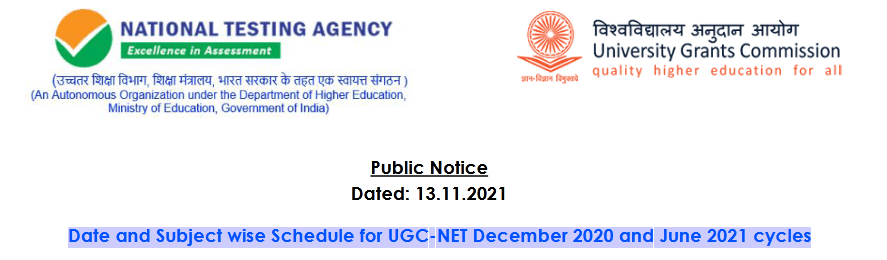
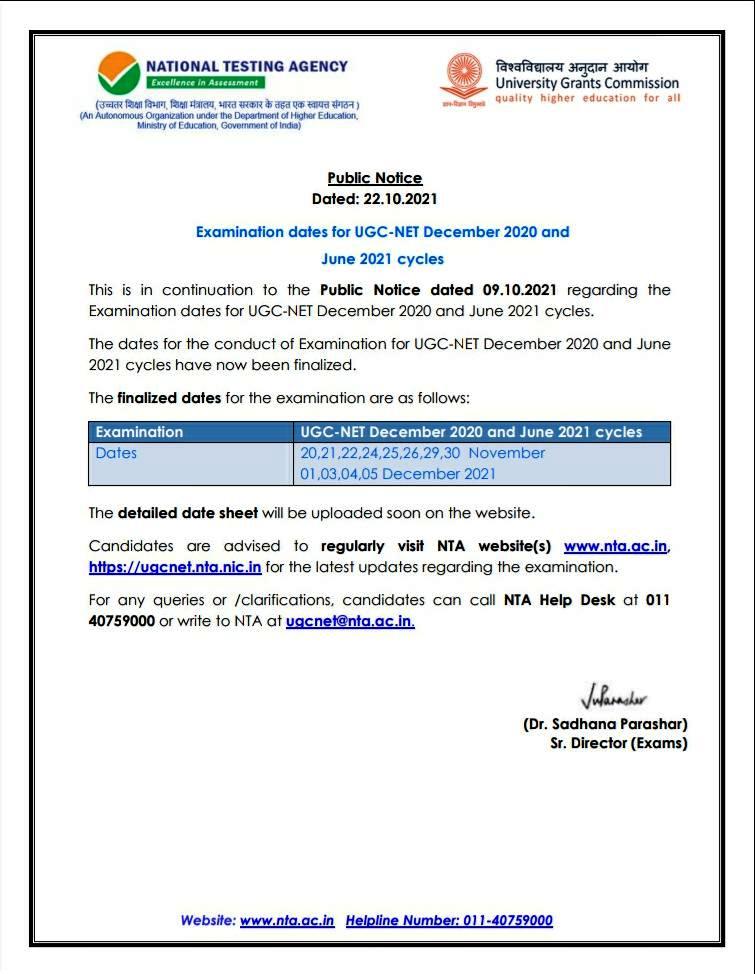
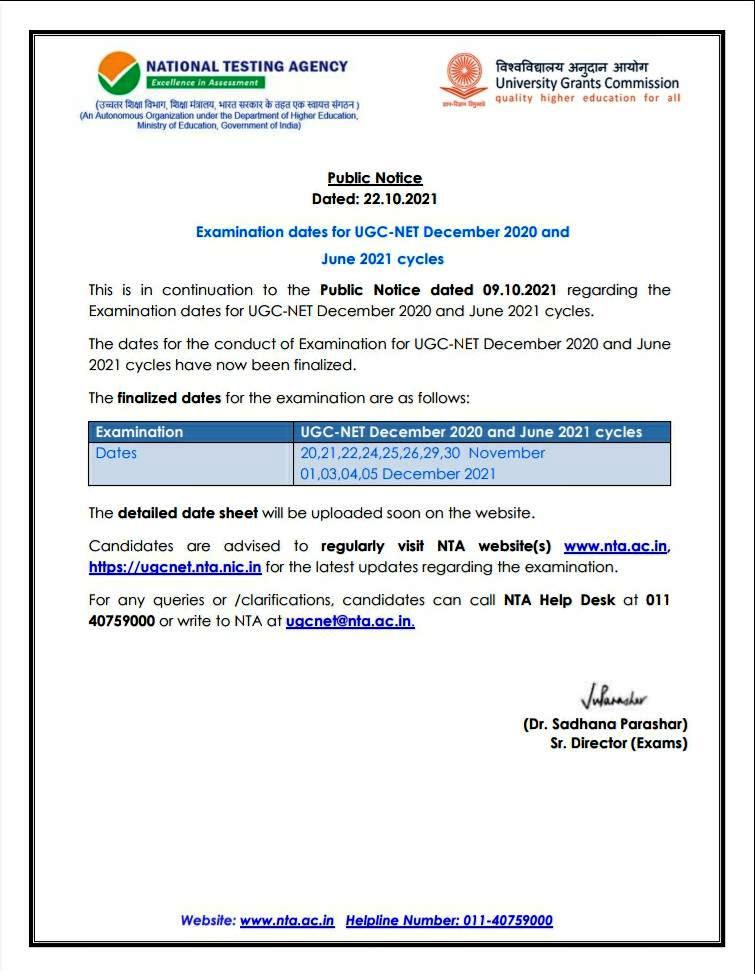
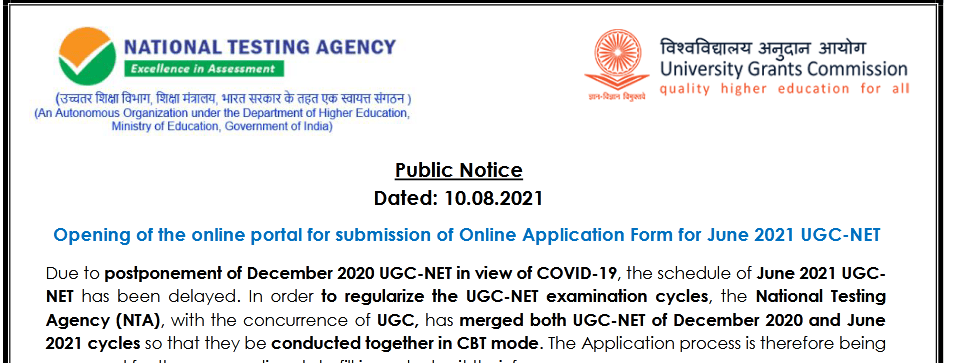
The National Testing Agency (NTA) is conducting the UGC- National Eligibility Test
(NET) December 2020 and June 2021 cycles for Junior Research Fellowship and eligibility
for Assistant Professor between 20, 21, 22, 24, 25, 26, 29, 30 November and 01, 03, 04 & 05
December 2021 in Computer Based Test (CBT) mode.
Admit Card is Available only for the Exam Date 20, 21, 22, 24, 25 and 26th Nov. 2021, For other Exam Date will Available soon. Download your admit card through the following link: https://ugcnet.nta.nic.in/
Computer Based Tests were completed for the date 20, 21 and 22nd November 2021. The memory based questions for the general paper is shared here for your reference. It will facilitate you towards success. Question pattern and concepts you will learn from this post. Answers for the questions indicated in Bold form. Best Wishes….
In an examination, 10,000 students appeared. The result revealed the number of students who have:
- Passed in all five subjects = 5583
- Passed in three subjects only = 1400
- Passed in two subjects only = 1200
- Passed in one subject only 735
- Failed in English only = 75
- Failed in Physics only = 145
- Failed in Chemistry only = 140
- Failed in Mathematics only = 200
- Failed in Bio-science only = 157
The number of students who passed in at least four subjects is:
- (1) 7900
- (2) 6300
- (3) 6900
- (4) 7300
The next term in the series is: 2, 5, 9, 19, 37, ?
- (1) 80
- (2) 73
- (3) 75
- (4) 78
The next term in the series: B2E, D5H, F12K, H27N,? is:
- (1) J56I
- (2) I62Q
- (3) Q62J
- (4) J58Q
A group of 210 students appeared in some tests. The mean of 1/3 rd of students is found to be 60. The mean of the remaining students is found to be 78. The mean of the whole group will be:
- (1) 80
- (2) 76
- (3) 74
- (4) 72
P and Q are brothers. R and S are sisters. The son of P is the brother of S. Q is related to R as:
- (1) Son
- (2) Brother
- (3) Uncle
- (4) Father
One day Prakash left home and walked 10 km towards south, turned right and walked 5 km, turned right and walked 10 km and turned left and walked 10 km. How many km will he have to walk to reach his home straight?
- (1) 30
- (2) 10
- (3) 20
- (4) 15
Consider the following assertion (A) and Reason (R) and select the correct code given below: (A): No man is perfect. (R): Some men are not perfect.
- (1) Both (A) and (R) are true but (R) does not provide sufficient reason for (A).
- (2) Both (A) and (R) are true and (R) provides sufficient reason for (A).
- (3) (A) is true but (R) is false.
- (4) (A) is false but (R) is true.
In certain code MATHURA is coded as JXQEROX. The code of HOTELS will be:
- (1) ELIPQB
- (2) LEQIBP
- (3) ELQBIP
- (4) LEBIQP
Consider the following statement and select the correct code stating the nature of the argument involved in it: To suppose that the earth is the only populated world in the infinite space is as absurd as to assert that in an entire field of millet only one grain will grow.
- (1) Astronomical
- (2) Anthropological
- (3) Deductive
- (4) Analogical
Among the following propositions two are related in such a way that they can both be true although they cannot both be false. Which are those propositions? Select the correct code. Propositions:
- (a) Some priests are cunning.
- (b) No priest is cunning.
- (c) All priests are cunning.
- (d) Some priests are not cunning.
- (1) (a) and (b)
- (2) (c) and (d)
- (3) (a) and (c)
- (4) (a) and (d)
Which of the following set of statements best describes the nature and objectives of teaching? Indicate your answer by selecting from the code.
- (a) Teaching and learning are integrally related.
- (b) There is no difference between teaching and training.
- (c) Concern of all teaching is to ensure some kind of transformation in students.
- (d) All good teaching is formal in nature.
- (e) A teacher is a senior person.
- (f) Teaching is a social act whereas learning is a personal act.
- (1) (a), (b) and (d)
- (2) (b), (c) and (e)
- (3) (a), (c) and (f)
- (4) (d), (e) and (f)
What are required for good teaching? Select the correct answer from the codes given below:
- (a) Diagnosis
- (b) Remedy
- (c) Direction
- (d) Feedback
- (1) (b), (c) and (d)
- (2) (c) and (d)
- (3) (a), (b), (c) and (d)
- (4) (a) and (b)
Attitudes, actions and appearances in the context of classroom communication are considered as:
- (1) Impersonal
- (2) Impersonal
- (3) Verbal
- (4) Non-verbal
Which of the following learner characteristics is highly related to effectiveness of teaching?
- (1) Prior experience of the learner
- (2) Educational status of the parents of the learner
- (3) Peer groups of the learner
- (4) Family size from which the learner comes.
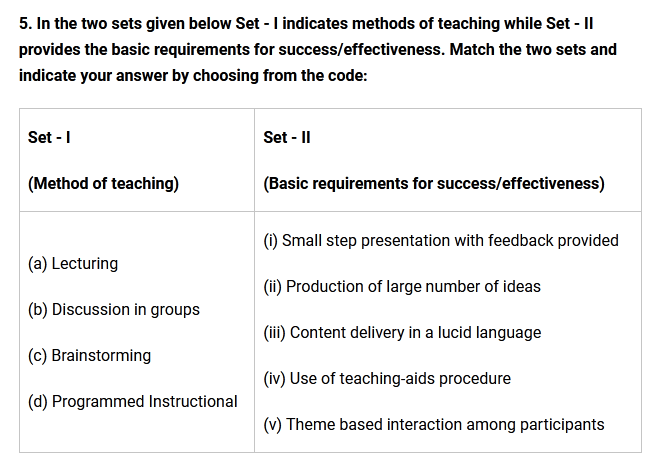
- (1) (i) (ii) (iii) (iv)
- (2) (ii) (iii) (iv) (v)
- (3) (iii) (v) (ii) (i)
- (4) (iv) (ii) (i) (iii)
Which of the following statements is not true in the context of participatory research?
- (1) It is a collective process of enquiry.
- (2) Its sole purpose is production of knowledge.
- (3) It recognizes knowledge as power.
- (4) It emphasizes on people as experts.
Which of the sets of activities best indicate the cyclic nature of action research strategy?
- (1) Reflect, Observe, Plan, Act
- (2) Observe, Act, Reflect, Plan
- (3) Act, Plan, Observe, Reflect
- (4) Plan, Act, Observe, Reflect

- (1) (ii) (iv) (iii) (i)
- (2) (v) (iv) (iii) (ii)
- (3) (i) (ii) (iii) (iv)
- (4) (ii) (iii) (iv) (v)
The problem of ‘research ethics’ is concerned with which aspect of research activities?
- (1) Following the prescribed format of a thesis
- (2) Data analysis through qualitative or quantitative techniques
- (3) Defining the population of research
- (4) Evidence based research reporting
Which of the following sequences of research steps is nearer to scientific method?
- (1) Suggested solution of the problem, Deducing the consequences of the solution, Perceiving the problem situation, Location of the difficulty and testing the solutions.
- (2) Perceiving the problem situation, Locating the actual problem and its definition, Hypothesizing, Deducing the consequences of the suggested solution and Testing the hypothesis in action.
- (3) Defining a problem, Identifying the causes of the problem, Defining a population, Drawing a sample, Collecting data and Analyzing results.
- (4) Identifying the causal factors, Defining the problem, Developing a hypothesis, Selecting a sample, Collecting data and arriving at generalizations and Conclusions.
Every type of communication is affected by its:
- (1) Reception
- (2) Transmission
- (3) Non-regulation
- (4) Context
Which of the following is not a principle of effective communication?
- (1) Strategic use of grapevine
- (2) Persuasive and convincing dialogue
- (3) Participation of the audience
- (4) One-way transfer of information
Attitudes, actions, and appearances in the context of classroom communication are considered as
- (1) Verbal
- (2) Non-verbal
- (3) Impersonal
- (4) Irrational
In communication, the language is:
- (1) The non-verbal code
- (2) The verbal code
- (3) Intra-personal
- (4) The symbolic code
Most often, the teacher-student communication is:
- (1) Spurious
- (2) Critical
- (3) Utilitarian
- (4) Confrontational
Which of the following are the characteristic features of communication? Select the correct answer from the codes given below:
- (a) Communication involves the exchange of ideas, facts, and opinions.
- (b) Communication involves both information and understanding.
- (c) Communication is a continuous process.
- (d) Communication is a circular process.
- (1) (a), (b), (c) and (d)
- (2) (a), (b) and (c)
- (3) (a), (b) and (d)
- (4) (b), (c) and (d)
Read the following two statements: I: Information and Communication Technology (ICT) is considered a subset of Information Technology (IT). II: The ‘right to use a piece of software is termed as copyright. Which of the above statement(s) is/are CORRECT?
- (1) Both I and II
- (2) Neither I nor II
- (3) II only
- (4) I only
Effectiveness of communication can be traced from which of the following? Select the correct answer from the codes given below:
- (a) Attitude surveys
- (b) Performance records
- (c) Students attendance
- (d) Selection of communication channel
- (1) (a), (b) and (d)
- (2) (a), (b), (c) and (d)
- (3) (a), (b) and (c)
- (4) (b), (c) and (d)
Assertion (A): Formal communication tends to be fast and flexible. Reason (R): Formal communication is a systematic and orderly flow of information.
- (1) (A) is false but, (R) is correct
- (2) Both (A) and (R) are correct and (R) is the correct explanation of (A)
- (3) Both (A) and (R) are correct, but (R) is not the correct explanation of (A)
- (4) (A) is correct but, (R) is false
Assertion (A): The initial messages to students in the classroom by a teacher need not be critical to establishing interactions later. Reason (R): More control over the communication process means more control over what the students are learning.
- (1) Both (A) and (R) are true, and (R) is the correct explanation of (A).
- (2) Both (A) and (R) are true, but (R) is not the correct explanation of (A).
- (3) (A) is true, but (R) is false.
- (4) (A) is false, but (R) is true.
Full form of COVID? CORONAVIRUS DISEASE–2019
MOOCs and SWAYAM Full form? Massive open online course (MOOC) & “Study Webs of Active-Learning for Young Aspiring Minds
CBCS full form? CHOICE BASED CREDIT SYSTEM (CBCS)
Where is the world’s largest solar power plant being built? largest photovoltaic power station in the world was the 850 MW Longyangxia Dam Solar Park, in Gonghe County, Qinghai, China.
How much of Indian land is vulnerable to earthquake? Almost 54%
NITI full form? National Institution for Transforming India
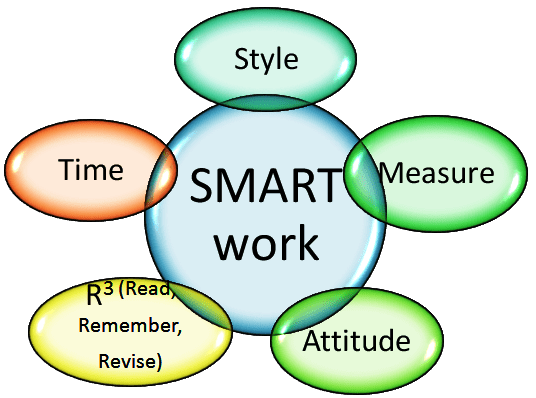
Just revisit the class videos… Most of the questions were covered in classes, materials and through online test.
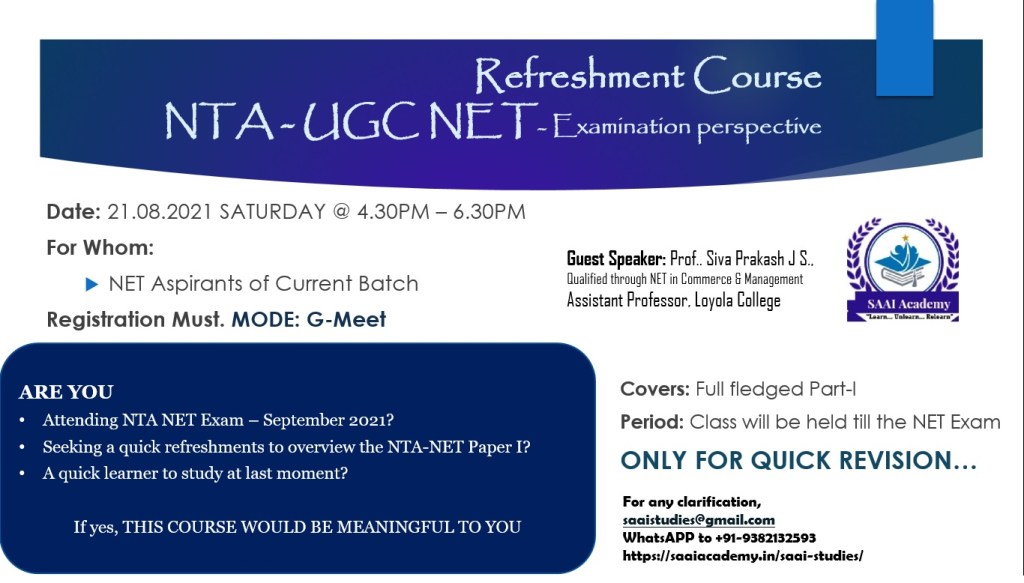
Easy ways to crack NTA UGC NET Exam: https://saaiacademy.in/2021/11/18/easy-ways-to-crack-nta-ugc-net-exams/
Best Wishes to crack your NET exam.. Happy learning… SAAI Academy, 9382132593





 SAAI Academy